The Common Core State Standards: A Thing Of The Past

The Common Core State Standards, which promise to make all students college and career ready are way behind the times and will not give our students what they need for their future. At the end of the two-minute video, which I invite you to watch, the competencies that will really make students “college and career ready” are quickly flashed on the screen. Not one of those competencies is a Common Core Standard for English Language Arts.

The competencies are:

  • Exploration
  • Creativity
  • Responsibility
  • Cultural Awareness
  • Collaboration
  • Accountability
  • Problem Solving
  • Innovation
  • Civic Engagement
  • Productivity
  • Communication
  • Initiative
  • Leadership

We English teachers know how to develop those competencies. Let’s do it. Reject the Common Core.

If you cannot see the video,  click here.

Should the Legislature Vote for Expansion of Charter Schools In the State Budget?

There IS truth in humor. Read and enjoy Colin McEnroe’s wonderful op-ed piece, which was in The Hartford Courant on May 17, 2015. Then please participate in the poll that follows the article.

Stop Spending Money on Charter Schools 

by Colin McEnroe

Every time you refuse to support charter school funding, God kills 1,000 kittens.

This point has been driven home repeatedly in Connecticut at rallies — one of which is taking place on your front lawn right this minute — and in advertising and by lobbying.
Once you’ve washed the kitten blood off your hands, I would urge you to join this movement. The first thing you must do is start a semi-mysterious advocacy group. By statute, the name of your group must contain the words “excellence,” “achievement” and “families.” Excellent Families for Achieving Excellence would be a good choice, but I believe it’s already taken.

Then you will need one or more jillionaire capitalist underwriters, such as Tony Stark, C. Montgomery Burns or Lex Luthor, although several of those are already taken too.

All set? Great. Time to work on your message. What are you going to say?

YOU: “Ummm, it’s time to stop flushing money down a non-functioning public school system. Why should they get all the money while we charter schools get the short end of the stick?”

Well done. It bears no resemblance to reality, but that may not be important. In fact, Gov. Dannel P. Malloy’s budget proposes new funding for charter schools while keeping public school funding essentially flat. So the charters, which currently educate only 1.5 percent of the school population, would get the prize while everybody else eats the Cracker Jacks.

Democrats in the legislature have pushed back against this plan, and the charter school advocacy community has responded by going nuts with advertisements, surface mail, rallies and email blitzes to legislators of such a staggering volume as to call into question whether they teach McMahon’s Law in the charter schools. McMahon’s Law, named after spending pioneer Linda McMahon, posits a definable tipping point at which money spent on your behalf will abruptly begin causing people to hate you.

How much money? Here I can rely on the excellent reporting of the Courant’s Kathleen Megan and Matt Kauffman and the Connecticut Mirror’s Jacqueline Rabe Thomas. All three are currently being held by Charter Moms for Family Excellence in Education Kidnapping Achievement, but I am confident of their future release, possibly in time for the Festival of the Beheading of Jonathan Pelto, the most sacred day on the charter school calendar.

Simple number: the charter advocacy groups have spent roughly $1 million during the current legislation session. It has been the kind of push legislators usually experience when private industry wants to store spent nuclear fuel rods in Gillette Castle or something. Weird number: they spent $14,000 at Subway recently to feed the people they bused to the state Capitol. What did we say about ordering those steak and bacon melts, people? You can scream just as loud on something from the $5 menu.

Disclaimer time! Many charter schools are full of hard-working people who get good results for their somewhat niche student bodies. Second disclaimer: anti-charter school paranoiacs can be as weird and obnoxious as their opponents.

But still, $1 million in influence peddling money does not come from people in mom jeans listening to Los Lonely Boys on their earbuds. It comes from Lord Business. What do the wealthy charter backers want? It seems like an odd stew of altruism and the never-ending goal of making education align more perfectly with the human resources department. Plus, it’s always fun to break one more union.

Here’s what I don’t get: why should the state spend any money — $32 million over two years as proposed by Malloy — to start new charter schools and expand old ones? Shouldn’t we be concentrating on our truly public schools, the ones that currently educate 98.5 percent of our students? You like charter schools? Fine. You start them.

Everybody knows Connecticut is facing an “education crisis” and that many of our schools are “broken” and “failing.” But the primary source for this kind of rhetoric is ConnCAN, one of the major charter advocacy groups.

There are probably a lot of nuances about the topic that have eluded me. Fortunately, some of the people for Achievement For Every Child Through Family Excellence are ringing my doorbell right now.

Colin McEnroe appears from 1 to 2 p.m. weekdays on WNPR-FM (90.5) and blogs at courantblogs.com/colin-mcenroe. He can be reached at Colin@wnpr.org.

Copyright © 2015, Hartford Courant

Please Take This Poll

New Seats For Public Charter Schools Are Not The Answer

The other night, I was making shrimp scampi for the first time.  The man behind the fish counter at Whole Foods had talked to me about the importance of de-veining the shrimp exactly right and predicted unpleasant results if I didn’t follow his directions precisely so I wasn’t paying attention to the news on the small kitchen TV.

Then, out of the corner of my eye, I saw an ad which told me that this sweet, forlorn little girl was about to have her locker, her school desk, her teacher, her friends, and even “her very self “taken away from her if the Connecticut legislature did not fund new seats in her public charter school.

1

Moreover, the ad said that 861 children would be denied access to new seats in public charter schools.  The ad concluded with a plea to Connecticut legislators to live up to their responsibility for all of Connecticut’s children.

I continued to de-vein the shrimp.

Several shrimp later, the ad came on again, and I watched it more intently.

I heard again about the sad plight of the lovely little girl and was shown how happy she had been before everything was taken away from her (See below).

 8

When I finished with the shrimp, I put the water on for the pasta. As I placed the cutting board I had used for the shrimp into the dishwasher, I looked to the TV, and there was the ad again. I saw once more how the little girl was overcome with sadness without her locker, without her desk, without her teacher, without her school, and without her very self.

 When the water boiled, I added the pasta. The pasta took seven minutes to cook.  As I drained the pasta, the ad came on once again.  I heard for the fourth time that the sweet little girl would have her locker, her desk, her teacher, her very self taken away from her, and it was the fault of the Connecticut legislature because legislators were threatening to not fund new seats in her charter school.

By this time, I had a lot of questions:

First of all, how would this little girl have her existing seat, locker, friends, and teacher taken away from her since it is new seats, not her seat, that are at stake in the state budget?

Also, who has the kind of money to run this ad four times in the time it took me to make a meal that the recipe said took 30 minutes?

 Why would that child in the ad be denied a locker, a desk, a teacher, and a school? Don’t we have public education in this country with lockers, desks, and teachers to which all students have a right?

Why would this child lose “her very self”, her whole identity, if she didn’t have a charter school?  What disservice was being done to her that she would feel adrift in the world without the identity of attending a charter school?  Who would foster that kind of cult-like allegiance?

 What happened to Brown vs. the Board of Education and Sheff vs. O’Neill?  Aren’t all children better off in classrooms of diversity?  The children in the classroom in the ad, as typical of charter schools, are all children of color.

 Why are the 861 children who could fill new seats in publicly funded but privately owned and privately managed charter schools more important than educating 98.5% of children in Connecticut who attend publicly funded and publicly accountable traditional public schools? Governor Malloy’s proposed state budget does not increase funds for traditional public schools but does call for an increase in funding for public charter schools.

 Watching this ad convinced me that the governor has the wrong priority in requesting the funding of new charter schools seats and not increasing funding for traditional public schools. Even more importantly, I became aware of how parents and children in Connecticut’s inner cities are being taken advantage of by those who own and run publicly funded, profit-making charter schools. Parents in Simsbury, South Windsor, Fairfield, and Mansfield, or any other suburban community would not tolerate a publicly funded but privately owned and managed charter school in their town.

 Can you imagine a neighborhood in West Hartford in which two or three of the children on the cul-de-sac attend a charter school, funded with $11,000 per student per year of taxpayer money and promoted as a superior school, while all the other children in the neighborhood attend what is said (by the charter school advocates) to be an inferior school also funded by taxpayer money?

 Can you imagine Avon supporting a public charter school although that school has no greater performance record than the Avon Public Schools? Measured by standardized test scores, which is the current American way of determining school excellence, about 50% of charter schools perform the same as their traditional public school counterparts although the charter school student population is more selective and has fewer special education students and fewer students with English as a second language. The other 50% of charter schools are about equally divided between some doing better than traditional public schools and others doing worse than traditional public schools. What is clear from reviewing the studies of charter school performance is that charter schools have not lived up to their claim to provide an education significantly and dependably better than traditional public schools.

Can you imagine New Canaan parents sending their children to an elementary school in which 23.78 % of the children are suspended as at a charter elementary school in New Haven (Achievement First’s Amistad Academy)? Or can you imagine Wethersfield parents sending their high school students to a charter school that suspended 58.6% of its students (Elm City College Prep) or 53.5% of its students (Bridgeport Achievement First) as compared to 25 % of high school students suspended from reform districts of “failing” schools and 12.3% as the state-wide average for high school suspensions?

Can you imagine a high school in Glastonbury in which 50% of the students who entered the school as ninth graders would be pushed out of that high school by senior year, thus producing a graduation rate of 50% although touted to be 100% because 100% of those not pushed out of the school did graduate? The graduation rates and college acceptance rates in Connecticut’s charter schools need to be scrutinized. For example, in 2013, Achievement First’s Amistad High School announced that 100% of its seniors were accepted to college. In reality, 38% of those who entered the high school in ninth grade were accepted to college, 25 students out of the original 64 ninth graders. The remaining 39 students were either held back in senior year or were no longer enrolled in the school.

 Can you imagine a school in Madison having a 20-45% teacher turnover rate with young, uncertified teachers who have no teaching experience coming in each year and staying for an average of 2.3 years as in most charter schools, including Achievement First schools in Connecticut? High teacher turnover affects the quality of the education because it impedes the development of instructional cohesion within the school or school district. Teacher turnover rate in charter schools is much greater than in traditional public schools, and teachers in charter schools are more likely to leave the profession than teachers in traditional public schools.

 Can you imagine the taxpayers of Greenwich supporting a school budget in which 10% of the budget went to a charter management company with no oversight by local or state taxpayers through the local Board of Education or the Connecticut General Assembly?

The answer to all for all of these questions: Of course not.

 Families For Excellent Schools, though, is asking the state legislature to give to our inner cities, through the funding of new charter school seats, a kind of education that would not be tolerated in our more affluent towns.

Below is the last frame of the ad:
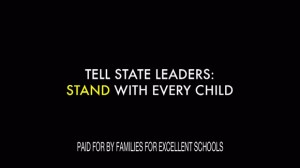
 11

The words of this last frame of the ad are correct. The Connecticut legislature must stand with all of Connecticut’s children, most of all those being victimized by the charter school establishment, funded by billionaires such as the Walton family, owners of Walmart. The Walton family underwrites the organization called Families for Excellent Schools and, among others who do not give their names, is responsible for the ad I saw four times before dinner.

Connecticut legislators have a public trust to deliver to ALL Connecticut children a well-funded, taxpayer-accountable, integrated, PUBLIC school with experienced, knowledgeable teachers and administrators involved in the school for the long term, dedicated to providing the best learning experiences possible, and committed to graduating all the students who enter their schools.

 It is the responsibility of legislators to give our inner city children the same quality of education that children in more affluent towns in Connecticut receive.  Those children do not deserve to be shuttled into academically limited, segregated, restrictive learning environments of  publicly funded but privately owned and privately managed charter schools. The legislature should not vote to fund the expansion of charter schools.  It makes no sense. It is simply wrong.

Put The Public Back Into Public Schools

Russ Walsh, an experienced curriculum director in school districts in New Jersey and Pennsylvania, regularly contributes considerable wisdom to the conversation about education through his blog called Russ on Reading (russonreading.blogspot.com). In this May 17th post, he points to the disaster that awaits us as a nation if support for public schools continues to erode. His post is below.

We in Connecticut right now are faced with a choice regarding state funding:  Do we support the public schools which serve all students or give public money to charter schools which will serve only a few students and, at the same time, provide private citizens with personal financial gain?

Derailing the Public Schools

                                       by Russ Walsh

As yet we don’t know what caused the horrific crash of the Amtrak train in Philadelphia this week. Human error? Mechanical malfunction? Delayed technology? The crash happened less than 20 miles from my home on a stretch of track that I travel regularly into Philly or Washington. As a frequent traveler, I can assure one and all of something certain: our train infrastructure has been allowed to fall into ignominious disrepair. A trip on the train these days is like traveling through the pages of a history book detailing the once glorious system of public works in this country, which has then been allowed to fall into a mess of barely functional tracks, dilapidated train stations, rusting bridges and routine lengthy delays. Why has this happened? Why in the age of European and Japanese bullet trains, does it take longer to take the train from Philadelphia to Washington today than it did 50 years ago?

Adam Gopnick, writing in The New Yorker, has the answer I believe. In a piece called “The Plot Against Trains”, he says:

“What we have, uniquely in America, is a political class, and an entire political party, devoted to the idea that any money spent on public goods is money misplaced, not because the state goods might not be good but because they would distract us from the larger principle that no ultimate good can be found in the state. Ride a fast train to Washington today and you’ll start thinking about national health insurance tomorrow.”

That train that derailed travelled right past the crumbling hulk of the junior high school my mother attended. In fact in travelling through Philadelphia the train passed dozens of crumbling dilapidated schools that were once pointed to with pride by the citizens and civic leaders of my home town. At one time we were justly proud of the fine edifices we constructed for our children to go to school and at one time those buildings housed the very best that public education had to offer in this country.

What happened? Many things happened, of course. There was the systematic creation of the ghetto brought on by federal, state and local housing policies after World War II (please see the work of Richard Rothstein on this phenomenon), there was “white flight” to the suburbs, but mostly this was the rise of the political philosophy, as Gopnick has pointed out in relation to trains and airports, that the government can ultimately do no good. In the large cities of America, we have exactly the schools we deserve because we have refused to invest in them.

This pathological, deeply ingrained distrust of government is perhaps best demonstrated by the House voting to cut Amtrak funding the day after the tragic accident, but it is also symbolized by the decision to privatize education. The charter school movement, the voucher movement, the entire narrative of “failing schools” and “bad teachers” is all a part of this refusal to provide adequate monies to provide for what we used to call “public works.” If, as Gopnick said, the dominant ideology is that no ultimate good can be provided by the state, why should we spend state monies on schools? Let the privatizers run the schools; the job is big, expensive and messy anyway.

Philadelphia, where the train accident occurred, is an object lesson in how to destroy a public school system. The system had been starved of funds for decades before any politician noticed. Then suddenly after systematically denying funds to the school system, politicians determined that the solution to the problem ridden public school system they created was charter schools. These schools then proliferated in the city, with very, very mixed results. Some did well, if test scores are your measure of improvement, some did poorly, some closed in the middle of the school year leaving students stranded, and some charter leaders defrauded the public out of their money. But good, bad, indifferent or criminal, all charters drained money from an already cash strapped school district and led to the further deterioration of this once great public institution.

All of this was intentional. All of this could have been avoided. All of this is the result of our refusal to appropriately meet our public responsibility.

The truth is that there are things that government can do better than private industry. Public transportation is one. Protecting the environment is another. Public schooling is the most important. Our refusal to provide the money needed to support public programs can be seen by anyone who rides a train, listens to climate change deniers or walks into an urban public school.

We need to wake up. We need to recognize that public monies well spent make life better for us all. We need to realize that the decay of urban school systems is a problem for all of us and it will take money from all of us to begin to fix it. I wish instead of using their great wealth to pursue their own flawed vision of schooling that plutocrats like Bill Gates and the Waltons would just pay their taxes and let us use the money on our public schools. It is time to take the private out of our schools and put the public, the whole of us, back into our public schools, because whether we choose to believe it or not, we all have skin in this game.

Say No to SBAC

Connecticut currently mandates the testing of public school students in grades 3, 4, 5, 6, 7, 8, and 11 with standardized tests produced by the Smarter Balance Assessment Consortium (SBAC). I am opposed to SBAC testing for English language arts because those tests neither measure authentic achievement nor foster students’ growth as readers, writers, and thinkers. Here are 10 reasons to STOP the harmful SBAC testing.

  1. SBAC tests are not rigorous.

The tests do not demand complex thinking. The tests are aligned to the Common Core standards, and the content of the Common Core Standards for English Language Arts is inferior content which does not serve to develop students as motivated, engaged readers and effective writers.

  1. SBAC tests are not field-tested for college and career readiness.

No one knows if a good score indicates that a student will be successful in college or careers or if a poor score indicates that a student will struggle in college or careers. According to Joseph Willholt, executive director of SBAC, there is a “large validity question “ about the tests in regard to college readiness.

The SBAC tests do not measure the skills students will need for the global workforce. Those needed skills are: to pose and shape critical questions, to collaborate with others of different cultures and points of view, to communicate effectively orally and in writing, and to use meta-cognitive skills (learning how to learn skills) when facing new problems. Other countries with which we compare ourselves measure those skills because they have standards for them, but we have neither the standards to teach those skills nor the SBAC tests to measure them.

  1. SBAC tests are not developmentally appropriate.

The Common Core English Language Arts Common Standards were not written by educators or those with knowledge of child and adolescent development. They were written by employees of testing companies. The content of the standards and of the SBAC tests is simply what test makers determined could be measured on standardized tests, not what is appropriate for students to learn or what fosters student growth as readers, writers, and thinkers. The National Council of Teachers of English did not endorse the Common Core because of the content of those standards,  the content SBAC tests measure.

  1. SBAC tests are capriciously graded.

The passing grade on the tests is arbitrarily set. On the high school SBAC tests, the passing grade is set such that 70% of students will be labeled as failing the math portion and 60% labeled as failing the English portion. The passing grade on SBAC has been set at what the highly respected National Assessment of Educational Progress considers a B+/ A- performance. SBAC labels all those who score a B or lower as failures.

  1. SBAC tests serve to widen the achievement gap.

The more time students spend preparing for SBAC tests, the less education they will have in authentic literacy learning. Time spent in test prep for SBAC robs students of reading, writing, and collaborating experiences which develop literacy skills. Schools with a history of low test scores spend concentrated time on test prep; schools with traditionally high test scores do not spend time on test prep. Therefore, the gap between those graduates with genuine skills in reading, writing, and collaborating will widen with students of privilege receiving a notably better education than students in schools with historically low test scores.

  1. SBAC tests discriminate against Connecticut’s neediest students.

Since all standardized test scores correlate with family income, many children of poverty will fail. How long will students be motivated to learn and how long will they stay in school if they fail tests in 3rd grade, 4th grade, 5th grade, 6th grade, 7th grade, and 8th grade? Not only are impoverished students receiving a poor education with Common Core but their dropout rate will also increase.

  1. SBAC tests narrow the curriculum.

Preparing students for  SBAC tests requires a high school English curriculum that strictly adheres  to the Common Core. That adherence severely limits  what students read, what thinking skills they learn as readers, what students write, and what kind of thinking skills they learn as writers.

Common Core limits the amount of literature read and totally eliminates teaching students the skills of questioning, making text connections to themselves and their world, and analyzing multiple and divergent interpretations  that reading literature offers. None of those skills are assessed on the SBAC test so are not part of the test prep curriculum many schools have adopted.

Similarly, that test prep curriculum  does not develop students as writers and thinkers. High school students are tested only on how they write formulaic arguments, graded either by computers or hourly employees hired through Craig’s List  and not required to have knowledge about the craft of writing.   Therefore, students do not have a curriculum rich in writing experiences  which develop their inductive, explorative,  and narrative thinking – all keys to success in higher education and the workplace.

  1. SBAC tests encourage poor pedagogy.

Because of the high stakes of the SBAC tests, English teachers, especially in schools with a history of low standardized test scores,, prepare students for the test by adhering to the pedagogy prescribed by the Common Core. It, however, is a flawed and discredited pedagogy prevalent in the 1940’s and 50’s and does nor prepare students to think complexly. Not only does that pedagogy severely restrict students’ development as readers and writers, it discourages many of them from even wanting to become readers and writers.

  1. SBAC tests will not “level the playing field”.

Connecticut is already doing well with literacy education.

Connecticut ranks higher than 62 nations in the reading performance of 15 year olds (according to the 2012 PISA- Program of International Student Assessment) and ranks highest in the country in reading performance of high school seniors (according to NAEP, the nation’s most authoritative measure of academic performance in reading and math). If standardized tests are thought to give us useful information, we already have that information.

We know that affluent areas of Connecticut provide an unparalleled education for their students, and we know that where students are impacted by poverty and racism, those students suffer. To level the playing filed, we need to provide for impoverished students what their more privileged peers have been given and standardize opportunities for learning for all students.

  1. SBAC tests teach the wrong values.

The tests teach children that competition, beating out other schools and other students, is what matters instead of the student’s own learning, the student’s own passion for ideas, the student’s own growth as a thinker, a reader, and a writer.

Connecticut educators can design assessments which measure the achievements students really need for their future. I have done considerable work with teachers in both affluent and impoverished districts to design assessments that measure critical thinking, creative thinking, collaboration, and oral and written communication for students of all abilities. Student achievement always exceeds original expectations when teachers are invited to do this work.

We CAN improve achievement in Connecticut for ALL of our students but not with SBAC tests.

Real Learning and Not-Real Learning in Kindergarten

In a prior blog post, I wrote about real learning and not-real learning in high school English classes. In writing about real learning and not-real learning in kindergarten classes, I found the intellectual processes for both age groups to be remarkably the same. Children in kindergarten and adolescents in high school are either asked to construct their own knowledge and create their own personal meaning or they are not. When either five years olds or fifteen years olds construct their own knowledge and create personal meaning, they are engaged in real learning. When they are told information and expected to remember it, they are recipients of not-real learning.

Here are two checklists you can take with you when you visit a kindergarten class of your child or of another child you love:

CHECKLIST FOR REAL LEARNING IN KINDERGARTEN

Children are active, involved participants in the classroom community. Children are encouraged to ask their own questions and explore possible answers. They are taught, through their play, to problem-solve, to think divergently and innovatively, to broaden and deepen their thinking by being in conversation with others, and, most of all, to learn how to learn as new situations and problems present themselves. Children create personal meaning and construct their own knowledge from meaning-making, interactive activities.

 If you can check all of the following boxes, this classroom is a good place for young children to grow and learn.

☐ Children are engaging in hands-on learning experiences.

☐ Children are learning through their play.

☐ Children are surrounded by and immersed in rich literature.

☐ Children are learning through activities and projects with others.

☐ Children are demonstrating social and emotional capabilities.

☐ Children are questioning, exploring, and following-through on their curiosity.

☐ Children are asked to stretch their imagination.

☐ Children figuring things out and drawing conclusions.

☐ Children are deeply involved in activities they find relevant to them.

☐ Children are using skills of literacy and numeracy in authentic learning experiences.

☐ Children are wondering about lots of things.

☐ Children are taught to persist in their learning challenges.

>>>>>>>>>>>>>>>>>>>>>>>>>>>>>>>>>>>>>>>>>>>>>>>>>>

CHECKLIST FOR NOT-REAL LEARNING IN KINDERGARTEN

The teacher conveys information to the children. Children answer the teacher’s questions. Children work by themselves and demonstrate individual mastery of specific skills. All the children in the class are expected to learn the same content and skills in the same way at the same time. Children are not asked to create their own personal meaning or construct their own knowledge.

If you check all of the following boxes, children in this class will need other kinds of learning experiences in order to grow as learners and thinkers.

☐ Children are practicing discrete literacy and numeracy skills with worksheets.

☐ Teachers are asking children questions for which the teacher has the answer.

☐ All of the children are being given reading instruction with the expectation that all of them will read by the end of kindergarten.

☐ Children are working individually to master skills.

☐ Children are listening to the teacher and gaining information.

☐ Children are having more “seat-time” than active, hands-on learning.

☐ Developing children’s social and emotional skills is limited or absent from the curriculum.

☐ College and career readiness is the purpose of instruction and the focus of the curriculum.

Rigor Or Not

Bulletin: The Common Core State Standards for English Language Arts are NOT rigorous!

How can that be? Everyone says they are.

The truth is that what is called rigor depends on who has the power to say what rigor is.

David Coleman, the chief author of the Common Core State Standards for English Language Arts who, however, has never taught English, has that power. He says that a chief reason that the Common Core has rigor is that narrative writing is cast aside in high school and not tested at all on Common Core–aligned tests for high school. He makes fun of narrative thinking and writing by saying that in the work environment no one is going to say to you, “Johnson, I need a market analysis by Friday, but, before that, I need a compelling account of your childhood.”

David Coleman’s and, therefore, the Common Core’s, definition of narrative is that it is a story, either true or fictional, written to entertain. And entertainment is not consistent with being “college and career ready”. All of the emphasis, therefore, in the Common Core high school English curriculum is on writing arguments in which a thesis is supported with evidence and developed by linear, deductive reasoning. Arguments do not explore multiple ways to look at a question or explain the story of how the writer came to think about a topic or develop an idea.

The Common Core specifies that arguments must be written in an anonymous, impersonal voice devoid of any personal story. David Coleman repeatedly has said that high school students must realize before they get to college or the workplace that: “ No one gives a **** what you think and feel”.

The National Council of Teachers of English has a much broader definition of narrative. The theme of the NCTE annual conference in November 2014 was “Story as the Landscape of Knowing”. There were 642 presentations at the conference, and only 19 of them were about implementing the Common Core with its limited definition of narrative.

Presentations at the NCTE Conference were about narrative as a way of fostering student engagement and motivation, narrative as a way to understand other people’s cultures or environments, narrative as a way to create student voice, narrative as a spur to innovative thinking, narrative as a way to learn any academic discipline, narrative as a form of persuasion, narrative as a way to create personal meaning and new knowledge, narrative as an impetus for social change, narrative as a way to inspire creativity, narrative as the beginning of inquiry, narrative as an expression of imagination, narrative as a reflection on one’s own process of learning, and narrative as the basis of collaboration among those with multiple perspectives.

It is no wonder that NCTE did not endorse the Common Core. The Common Core’s treatment of narrative does not come close to the concept of narrative expressed in hundreds of presentations at the NCTE conference. Those presentations explained narrative as a way of thinking and a way of knowing. Now that is real rigor!

Not only is narrative as a way of thinking and a way of knowing rigorous for high school students, it is precisely the skill needed for our future as a democracy and an economy. In his recent book, Creating Innovators, Tony Wagner of Harvard University points out that our future as a nation depends on our capacity to teach students to have the curiosity and imagination to be innovators. Fostering curiosity and imagination begins with students knowing their own stories and being able to tell them, engaging with a diversity of perspectives offered by the stories of others, seeing the stories implicit in theories and concepts, and envisioning new stories and new possibilities. We can teach students to be innovators, but we can’t do it without narrative thinking.

Human beings are hard-wired for stories. It is how our brains work. We think in stories. We are moved by stories. We create new ideas through stories. We need to unleash that brainpower in our students so that they live empowered lives and contribute to their society in meaningful ways.

Let’s begin here in Connecticut demanding real rigor for our students and not allowing them to settle for the limited education offered by the Common Core.

An Invitation to Connecticut Educators

There is a lot of conversation about public education going on.

Politicians are talking about the Common Core in regard to federal vs. local control. Billionaires with no understanding of child or adolescent development are mandating what education should look like in every grade from kindergarten through high school graduation. Testing companies are dictating that what is taught is limited to what they know how to test. Entrepreneurs are saying that schools should be enterprises from which they make a profit. Journalists are writing about the worth of standards they have never read. State legislators require students to take tests which determine promotions and graduations although no one has any idea if those tests measure what it takes to be successful in higher education or the workplace. The chief writer of the English language arts standards tells teachers exactly how to teach although he has never taught himself and is shockingly unfamiliar with good pedagogy. Proponents of the standards claim that the standards are evidence-based and internationally benchmarked although they are neither.

All in all, the ongoing conversation is dominated by a combination of those who have not read the standards, those who have never taught, and those who have little or no knowledge of child development, including how children and teenagers learn.

The Common Core and the accompanying tests are not receiving the scrutiny they deserve so implementation marches on. As a result, students do not experience the passion for learning, the engagement with ideas, or the substantive content to which they have a right.

It’s time for public school educators to reclaim the conversation so that Connecticut’s students receive the education they need. In Connecticut, we have innumerable educators who are experts in their academic disciplines and practice effective pedagogy. We have many excellent teachers and administrators who mentor inexperienced teachers and administrators. We have renowned educators in both our public K-12 schools and at our universities who are experts in child and adolescent development and who know how to shape instruction that fits that development. We have many accomplished administrators who know how to create collaborative school environments in which both students and teachers grow and learn. We have an untold number of teachers in our public schools who know how to inspire students to be critical thinkers, pose pivotal questions, read thoughtfully, communicate effectively, construct individual meaning by interacting with other thinkers, and gain the skills of learning how to learn. We have educators in Connecticut who prepare our children for the future instead of equipping them for the past as Common Core does.

If we educators start talking about what we know, perhaps the public, the politicians, and the journalists will listen and give the Common Core and the accompanying testing the scrutiny they warrant. Our conversation, however, will not deter corporate “reformers” and test makers because their interest is in making a profit off our children, not in the quality of their education.

This blog provides a space for educators to talk to one another and to the public about what real learning is and how excellence can be provided for all Connecticut students. If we educators share with one another what we know from our teaching, from our research, and from what we have learned from our students, there will be no stopping us, no stopping what we can do for Connecticut’s students.

Let’s aim big. Let’s make real learning available to all Connecticut’s students. Let’s join with other educators across the nation as two University of Arkansas professors of education, Jason L. Endacott and Christian Z. Goering (read here), rally us together with this summons:

Let’s take back the story on education by any nonviolent means necessary… Just when it seems that all of the money and all the of the influence is stacked up against us, we can absolutely recapture our schools for the sake of our children. Stand together and say it: Our children aren’t products, aren’t numbers, and aren’t for sale.

Let’s start talking on this blog. Let’s explore key questions and highlight current issues. I invite you to offer your own posts – posts you write yourself or articles, photos, or videos you find provocative. I urge you to take the surveys and comment on the postings. I especially ask you to submit descriptions of a moment or activity or unit of study from your classroom that demonstrates real learning.

We will then do more than reclaim the conversation about education. We will shape that conversation. We will elevate that conversation. We will focus that conversation. At last, the conversation will be about what we know best and what students need most: real learning.

Here are some conversation starters for you:

What is real learning?
How can all of Connecticut’s students have real learning opportunities?
What is the content or the substance of the Common Core standards?
How are the Common Core standards related or not related to real learning?
What do we know from research and from our experience as teachers about the cognitive development of children and adolescents?
How do we engage students as learners and thinkers?
How can we, as the state with the largest achievement gap, close that gap?
How can we, as a state, promote equity?
Do the SBAC tests measure real learning?
How do we best prepare students for their future?
What do you think? Let the conversation begin…